Vendors change. Your mobility policy shouldn’t.

By Roeland Vanrenterghem, CEO Vaigo
The email usually arrives in the second half of the year. Your fuel card provider is stopping its service on 31 December. Or your parking app has been taken over, and you move to a new platform on 1 October, with a few weeks’ notice.
In the past few weeks alone, I sat at the table with several large employers in exactly this situation. The mobility market is consolidating: providers exit, merge and replace their cards. Sometimes you want to switch yourself, for a better tariff, better coverage or a tender.
Everyone focuses on the new vendor. The real question is a different one: where does your policy live?
Every vendor needs your policy, every month
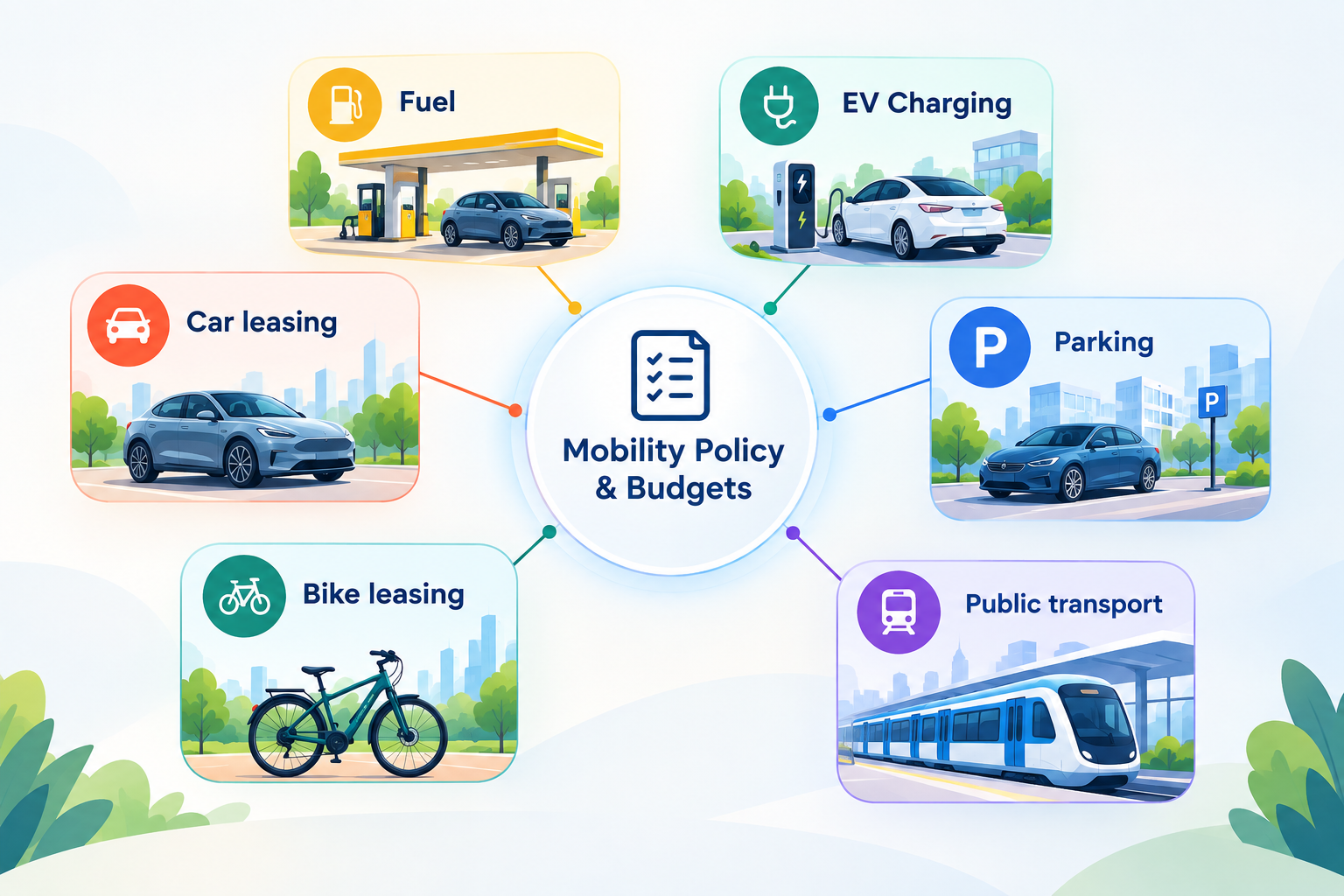
A large employer doesn’t manage one mobility vendor. It manages six categories, often with more than one supplier per category:
- Fuel and EV charging cards
- Home charging
- Parking
- Public transport
- Car leasing
- Bike leasing
None of these vendors knows your policy. You have to feed each of them, every month, with the same four things: who is eligible, which budget applies, what is out of policy, and whether the invoice is correct.
| Vendor | Who is eligible | Budget | Out of policy | Invoice |
|---|---|---|---|---|
| Fuel & EV charging | A card per entitled employee; blocked at exit | Monthly or annual limit per profile | Private or foreign sessions, idle fees, fuel outside the rules | Transactions matched to active cards |
| Home charging | Company-car drivers with a home charger | Reimbursement at the rate set in your policy | Sessions outside the rules | Monthly settlement via payroll |
| Parking | Who may park, for business trips and for commuting | Monthly cap or approval flow | Parking above the cap or without approval, private use | Vendor data matched to users and policy |
| Public transport | Commuters per profile | Subscription or tickets, employer contribution | Travel outside the policy, unused subscriptions | Operator invoice matched to current employees |
| Car leasing | Entitlement by function or grade | TCO reference, own contribution | Options above budget, fines, damage | Lease costs assigned to the right employee and budget; damage and out-of-policy extras charged to the employee, according to policy |
| Bike leasing | Who may lease | Monthly lease cost via salary or cafeteria plan | Contracts that no longer match the profile | Lease costs assigned to the right employee and budget |
That is six vendors and four jobs, every month: 288 recurring tasks a year. They are spread across HR, payroll, fleet and finance, done in spreadsheets, and dependent on a few people who know how it works.
What the four jobs look like in practice:
- Who is eligible: user lists. Every joiner, leaver, promotion, contract change or move to another entity means an updated list for each vendor. Miss one, and a leaver keeps an active card.
- Budget management: budgets synced. Budgets per profile, with pro rata for joiners, top-ups and carry-over, have to reach every vendor as limits. Today that is often an Excel file, sent monthly.
- Out-of-policy transactions: detected. A limit isn’t a policy. Private charging sessions, parking above the budget and fuel on a weekend abroad all have to be checked against the rules. Then someone has to decide: blocked, accepted, or charged to the employee.
- Invoices: controlled. At the end of the month, each vendor sends an invoice. Someone has to check it against the transactions and the user list, and assign every cost to the right employee and budget, before finance pays.
Why a vendor change hurts so much
Because the policy lives inside the vendors, a vendor change resets all four jobs:
- the user lists have to be rebuilt in a new portal,
- the budgets have to be re-entered in a new format,
- the checks have to be re-learned on new data,
- the invoice control has to be rebuilt from scratch.
In an organisation with 1.000+ employees, several profiles and more than one legal entity, that isn’t a migration. It’s a re-implementation, and it usually lands in the busiest quarter of the year.
There is a quieter risk as well: the new vendor may control less than the old one did. Some can’t block a transaction upfront. Some only publish data after invoicing.
Nobody writes that down in the migration plan. But your policy slides from enforced to corrected afterwards. Corrections cost payroll reruns, emails to employees, and money you never recover.
Hand the four jobs to your digital employee
Vaigo isn’t another portal for HR to run. It’s a digital employee in your mobility team: software, AI and mobility specialists who take over the work. HR defines the policy once. Vaigo does the rest, every day, for every vendor:
- Keeps the user lists right. Every joiner, leaver and change comes in through the nightly HR sync, and Vaigo updates each vendor. Nobody uploads a list again.
- Manages the budgets. Budgets per profile, pro rata, top-ups and carry-over are calculated by Vaigo and synced to each vendor.
- Catches out-of-policy spending. Every transaction is checked against your rules. It is blocked where the vendor allows it, and charged to the employee through payroll where it doesn’t. The same goes for damage and extras on a lease car.
- Controls the invoices. Each vendor invoice is matched to the transactions and the user list. Every cost is assigned to the right employee and budget before finance pays.
- Delivers to payroll. The output is payroll-ready data in your existing payroll codes, with one audit trail.
Fuel and EV charging cards, home charging, parking, public transport, car leasing and bike leasing connect as suppliers. Swap any of them without touching your policy.
| Today, per vendor | With Vaigo, your digital employee | |
|---|---|---|
| Who is eligible | Lists uploaded manually after each joiner, leaver or change | Driven by the nightly HR sync; vendors updated automatically |
| Budgets | Excel files sent, limits entered per portal | Budgets per profile, with pro rata and top-ups, synced to each vendor |
| Out of policy | Spotted afterwards, if at all | Every transaction checked; blocked where the vendor allows it, charged to the employee through payroll where it doesn’t |
| Invoices | Checked by hand, or not checked | Matched to transactions and the user list; every cost assigned to the right employee and budget |
| Vendor change | All four jobs rebuilt | The policy stays; a new supplier is connected |
Three examples from real operations
A leaver with an active card. An employee leaves on 15/02. Their fuel card is used on 20/02.
- With a manual user list, you find out in April, if at all.
- With Vaigo, your digital employee closes eligibility on the exit date through the HR sync. The card is deactivated at the vendor, and any transaction after the exit date is flagged in the invoice check.
A parking vendor that can’t block. The policy allows €60,00 a month for business parking, and the new provider only delivers data after invoicing. In March, an employee parks for €84,00.
- When the data arrives, your digital employee matches it to the policy and flags €24,00 as out of policy.
- It charges that amount to the employee in the next payroll run, under the same wage code the employee sees in the app and on the payslip.
- No email thread, and no cost absorbed.
A fuel card migration. 400 employees have a monthly budget of €75,00 or €150,00, and the provider stops at year-end.
- Eligibility, budgets, validation rules and the payroll mapping stay in Vaigo.
- The new cards are linked to the existing budgets.
- HR chooses the vendor and approves the employee communication. Your digital employee handles the rest.
The freedom to choose
When your policy doesn’t live in the vendor, switching becomes cheap, and you negotiate differently. You choose on price, coverage and service, not on how painful it would be to leave.
Vendor lock-in is rarely a contract problem. It’s a policy problem: whoever holds your rules holds your leverage.
What changes
- Who does less work: HR stops uploading user lists and sending budget files. Payroll stops correcting afterwards. Finance stops checking and allocating invoices by hand.
- What risk is removed: no active cards for leavers, no enforcement gap when a vendor changes, and no policy that weakens because a new vendor can’t block.
- What cost becomes predictable: out-of-policy spend and lease-car damage are charged to the employee according to policy instead of absorbed. Invoices are paid only for valid transactions, and vendors are chosen on their merits.
Vendors come and go. You keep the policy. Your digital employee keeps doing the work: the user lists, the budgets, the out-of-policy checks and the invoices, whichever vendors sit underneath.
Facing a vendor change before year-end? Let’s map what your digital employee can take over, in a single conversation.