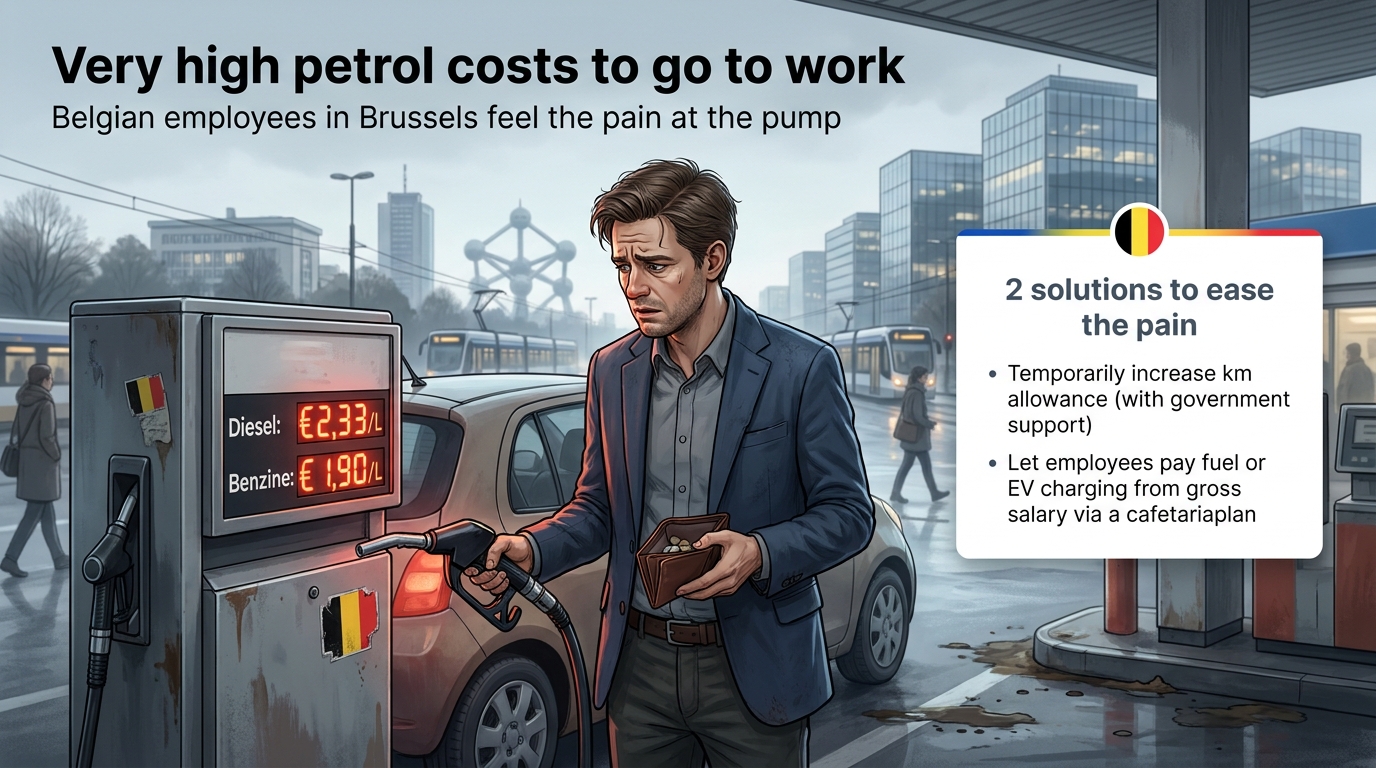
Fuel Prices Up 20%. Two Things You Can Do to Ease the Pain for Your Employees.

Filling up the tank costs over €100 these days. Petrol is approaching €1,90 per litre. Diesel sits at €2,33.
For the average Belgian car commuter — 21 km to the office, 42 km round trip, 20 working days a month — that’s roughly 840 km and 59 litres of fuel. At €1,90 per litre, that’s €112 per month just to get to work and back. Out of their net salary.
Your employees feel it. And they’re looking at you.
The good news? The Belgian government just announced a temporary energy support package worth €80 million. €60 million of that goes directly to commuting. And there’s a smart way to use it — one that costs you very little and gives your employees real relief.
Here are two concrete things you can do right now.
1. Give your employees a temporary km-allowance boost — the government will help pay for it
Many employers have kept their kilometre allowance for car commuters flat for years. Public transport and cycling allowances went up. The car allowance didn’t. With fuel prices surging, that gap is starting to hurt.
The federal government’s new energy accord, announced on 22 April 2026, offers a direct solution: a temporary tax credit for employers who increase their km-allowance.
Here’s how it works:
- If you increase the km-allowance by up to 20%, with a maximum of €0,10/km, the government compensates the full cost via a fiscal credit.
- If you introduce a new km-allowance of at least €0,10/km, the government covers 20% of the cost.
- The extra allowance is not taxed for the employee — it’s net money in their pocket.
- The measure runs for 3 months: May, June, and July 2026.
This is a rare window. A small, time-limited increase that costs you almost nothing — and makes a real difference for employees who depend on their car to get to work.
What to do after those 3 months?
That’s up to you. You can roll back to the original rate. Or you can keep the increase — partially or fully. Either way, you’ve shown employees you respond when it matters.
But here’s the smarter play
If you increase the allowance, ask something in return: let employees register each commuting trip. No more paying a flat monthly amount for days they work from home or don’t show up. You pay for the trips that actually happen — nothing more.
Most employers today still pay a fixed commute allowance regardless of whether the employee comes to the office 20 days a month or 8. In a hybrid work environment, that’s a significant overspend. A simple commuting calendar fixes that instantly.
Pro tip: use that same commuting calendar to let employees register bike days too. The bicycle allowance (€0,37/km, fully tax-free) stacks on top of the car allowance. An employee who bikes two days and drives three earns more net than someone who drives every day. And your total cost? Lower.
You can even go one step further: buy their flexible train tickets, subscriptions, and bus passes through the same system. One calendar, every mode, every fiscal benefit — automatically calculated and exported to payroll.
2. Let your cafetariaplan employees pay for fuel with their gross salary
Belgium has over 570.000 company cars on the road. Roughly half of those are salary cars — vehicles that exist primarily as a compensation tool, not a business need. And a growing share of those salary cars are financed through a cafetariaplan, where employees exchange part of their gross salary or optimise their 13th month to lease a vehicle.
The cafetariaplan covers the car, the insurance, and the maintenance. But it typically doesn’t cover fuel. With diesel above €2,30, that’s a painful gap in the employee’s net budget — and it’s one you can fix easily.
The fix is simple: add a fuel card or EV charging card to the cafetariaplan. Employees use a portion of their gross salary to pay for fuel or charging — at a much lower effective cost than paying out of their net income. The tax efficiency of gross-to-net conversion means they get significantly more purchasing power per euro.
For EV drivers, this extends to charging sessions at home, at work, and on the road. One card, all charging points.
Keep it controlled
The obvious concern: overspending. With Vaigo, employees simply cannot overrun the budget dedicated from their cafetariaplan. The fuel or charging card is hard-capped to the amount available — no exceptions, no surprises. Full visibility for HR, zero risk of budget overruns.
It’s not a blank cheque. It’s a defined, tax-efficient benefit that protects employees against fuel price volatility — within the exact boundaries of their personal cafetariaplan budget.
The bottom line
Fuel prices are out of your control. Your response isn’t.
Two levers, both available right now:
- Increase the km-allowance temporarily — the government compensates via a tax credit. Ask employees to register their trips in return. Use the same calendar for bike days and public transport. Pay only for what actually happens.
- Add fuel and EV charging to your cafetariaplan — let employees pay from gross salary, with a capped budget. More purchasing power, zero risk of overspend.
Neither of these requires a policy overhaul. They’re practical, targeted, and available today.
At Vaigo, we help employers activate both of these — fast. Our platform lets you set temporary allowance increases, manage a per-trip commuting calendar across all modes, and integrate fuel and charging budgets into your flexible reward plan. Everything syncs to payroll automatically. Talk to us →